
Understanding Voice over IP (VoIP): Architecture, Protocols, and Fundamentals
Overview
This guide provides a foundational overview of Voice over Internet Protocol (VoIP) technology, explaining how real-time voice communications are transmitted over IP networks. Readers will learn about core VoIP network components, the separation of signaling and media planes, audio codec choices, and key challenges such as NAT traversal and QoS.
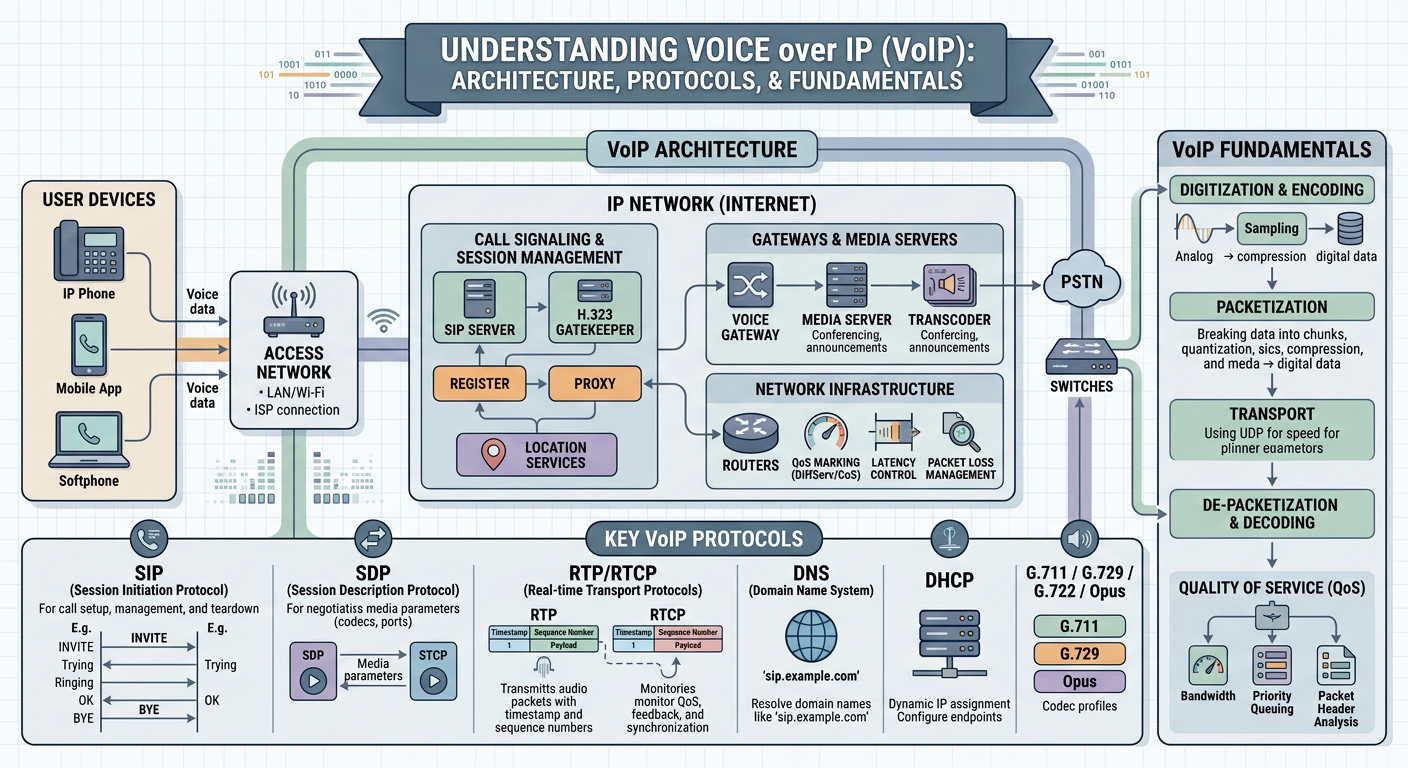
Key takeaways
- VoIP converts analog voice signals into IP data packets for transmission over packet-switched networks.
- VoIP architecture strictly decouples call signaling (e.g., SIP) from media transmission (e.g., RTP/RTCP).
- Audio codecs (G.711, Opus, G.729) determine voice quality, packet size, and bandwidth utilization.
- Session Border Controllers (SBCs) and SIP proxies secure network perimeters and manage cross-network routing.
- NAT traversal mechanisms like STUN, TURN, and media proxying are critical for bidirectional audio flow.
Prerequisites
- Basic understanding of IPv4/IPv6 networking and OSI layers.
- Familiarity with UDP, TCP, and DNS protocols.
Guide
- section #1
Introduction to Voice over IP Voice over Internet Protocol (VoIP) is a suite of technologies and standards that enable real-time voice communications and multimedia sessions over Internet Protocol (IP) networks. Unlike traditional Public Switched Telephone Networks (PSTN) that depend on dedicated circuit-switched channels, VoIP digitizes audio signals, breaks them into discrete data packets, and routes them dynamically across shared packet-switched networks. This transition lowers operational costs, eliminates distance-based billing models, and seamlessly integrates voice with modern application software.
- section #2
The Dual-Plane Architecture: Signaling vs. Media VoIP architectures enforce a strict separation between call control and actual audio transmission. The signaling plane establishes, manages, modifies, and tears down sessions using protocols like Session Initiation Protocol (SIP). The media plane operates independently once the session parameters are established, delivering digital audio payloads endpoint-to-endpoint using Real-time Transport Protocol (RTP). Real-time Transport Control Protocol (RTCP) runs alongside RTP to monitor transmission statistics, providing telemetry on packet loss, jitter, and latency.
sipINVITE sip:user@example.com SIP/2.0 Via: SIP/2.0/UDP 192.168.1.50:5060;branch=z9hG4bK776asdhds From: <sip:alice@example.com>;tag=1999a88 To: <sip:user@example.com> Call-ID: c274810a908@192.168.1.50 CSeq: 1 INVITE Contact: <sip:alice@192.168.1.50:5060> Content-Type: application/sdp Content-Length: 142 v=0 o=alice 2890844526 2890844526 IN IP4 192.168.1.50 s=- c=IN IP4 192.168.1.50 t=0 0 m=audio 49170 RTP/AVP 0 8 101 - section #3
Audio Digitalization and Codecs Analog audio captured by a microphone must be converted into digital data using a encoder/decoder (codec). Codecs balance audio quality, latency, and bandwidth consumption. Legacy narrowband codecs such as G.711 (µ-law/a-law) sample audio at 8 kHz and consume 64 kbps of uncompressed network bandwidth per channel. Modern wideband and fullband codecs, such as Opus, dynamically adapt frame sizes, sample rates, and bitrates (ranging from 6 kbps to 510 kbps) to deliver high-fidelity HD voice even over lossy or congested network connections.
- section #4
Core VoIP Network Components A complete enterprise or carrier VoIP deployment consists of several specialized roles. User Endpoints (hardphones, softphones, WebRTC clients) originate and terminate sessions. IP-PBXs or Softswitches (e.g., Asterisk, FreeSWITCH) manage internal routing, queues, and business logic. SIP Proxies and Registrars (e.g., Kamailio, OpenSIPS) handle location tracking and high-throughput routing. Session Border Controllers (SBCs) sit at the public/private network boundaries to provide topology hiding, protocol interworking, and stateful security enforcement.
- section #5
Overcoming NAT and Firewall Challenges Network Address Translation (NAT) presents a common obstacle in VoIP deployments because private IPv4 addresses embedded in SIP and SDP headers are unroutable over the public Internet. Furthermore, dynamic UDP media ports opened by RTP are frequently blocked by restrictive firewalls. VoIP networks overcome this using edge media relays, SBC far-end NAT traversal, or protocol mechanisms such as STUN (Session Traversal Utilities for NAT), TURN (Traversal Using Relays around NAT), and ICE (Interactive Connectivity Establishment).
- section #6
Security and Quality of Service (QoS) Because VoIP relies on real-time packet transport, network performance directly impacts call clarity. Implementing Quality of Service (QoS) mechanisms like Differentiated Services Code Point (DSCP) classification—specifically setting audio packets to Expedited Forwarding (EF)—ensures routers prioritize media traffic over delay-tolerant data traffic. Security requires encrypting both architectural planes: SIP signaling is secured via Transport Layer Security (TLS), and audio payloads are encrypted using Secure Real-time Transport Protocol (SRTP).
Further reading
- RFC 3261 - SIP: Session Initiation Protocol
- RFC 3550 - RTP: A Transport Protocol for Real-Time Applications
- RFC 6716 - Definition of the Opus Audio Codec
- NIST Special Publication 800-58: Security Considerations for Voice Over IP Systems