
Understanding STUN (Session Traversal Utilities for NAT) in VoIP Architecture
Overview
This guide provides a comprehensive technical overview of Session Traversal Utilities for NAT (STUN) and its role in real-time IP communications. Readers will learn how STUN enables endpoints behind Network Address Translation (NAT) to discover their public IP address and port mappings. The article details STUN packet exchange mechanisms, NAT classification handling, integration into SIP/SDP workflows, and its structural place within ICE frameworks.
Key takeaways
- STUN allows endpoints behind NAT to discover their reflexive (public) IP address and UDP port mapping.
- RFC 5389 replaced the obsolete RFC 3489 classic STUN specification, introducing XOR-MAPPED-ADDRESS to prevent broken ALG manipulation.
- STUN operates successfully across Full Cone, Address-Restricted, and Port-Restricted Cone NAT topologies.
- STUN fails when faced with Symmetric NATs because port mappings change dynamically per destination target, requiring TURN as a fallback.
- Modern VoIP applications typically utilize STUN as part of the Interactive Connectivity Establishment (ICE) framework rather than as a standalone protocol.
Prerequisites
- Fundamental knowledge of IPv4 networking, TCP/UDP transport, and NAT mechanics.
- Basic understanding of SIP signaling (RFC 3261) and SDP payload structure (RFC 4566).
- Familiarity with RTP packet flows in VoIP call flows.
Guide
- section #1
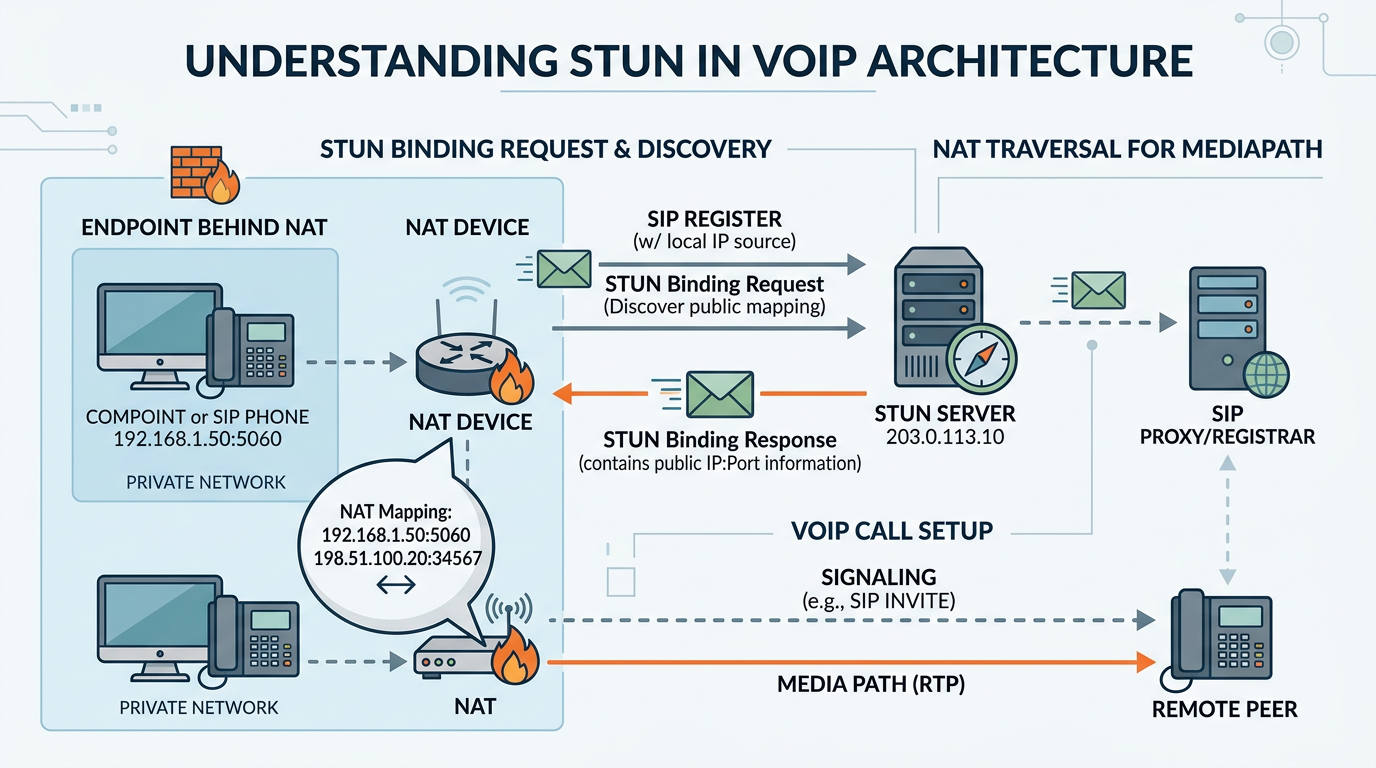
The NAT Traversal Challenge in Real-Time Communications Network Address Translation (NAT) allows multiple private devices to share a single public IP address, protecting internal network topology. However, application-layer protocols like SIP and RTP embed IP addresses and transport ports directly inside their packet payloads (such as the SIP Contact header and SDP c= and m= lines). When an endpoint behind a NAT originates a call, it advertises its private IP address (e.g., 192.168.1.50) inside the SIP/SDP metadata. The remote gateway tries to send media back to this unroutable RFC 1918 private address, resulting in one-way or completely silent audio. STUN addresses this issue by providing a mechanism for endpoints to discover their external, public-facing transport addresses before constructing SIP signals.
- section #2
STUN Protocol Operation and Binding Requests STUN operates on a client-server architecture over UDP (default port 3478) or TLS (port 5349). When a VoIP client initializes, it sends a STUN Binding Request to a known public STUN server. As this packet traverses the client's local NAT router, the router allocates a public IP and port mapping, altering the IP packet headers. Upon arrival, the STUN server inspects the source IP and source UDP port of the incoming packet. It constructs a STUN Binding Response containing these discovered public credentials inside a STUN attribute (XOR-MAPPED-ADDRESS) and returns it to the client. The client extracts its reflexive address from the response and uses it to populate SDP payloads accurately.
text+-------------+ +-------------+ +-------------+ | STUN Client | | NAT Router | | STUN Server | +------+------+ +------+------+ +------+------+ | | | | Binding Request | | | Src: 192.168.1.50:5060 | | +---------------------------->| Binding Request | | | Src: 203.0.113.10:15060 | | +---------------------------->| | | | | | Binding Success Response | | | XOR-MAPPED-ADDRESS: | | | 203.0.113.10:15060 | | |<----------------------------+ | Binding Success Response | | |<----------------------------+ | | | | - section #3
STUN and NAT Topologies: Cone vs. Symmetric NATs STUN success depends heavily on the underlying NAT behavior classification. In Full Cone, Address-Restricted Cone, and Port-Restricted Cone NAT configurations, once a internal private socket opens a mapping to a STUN server, the NAT router reuses that identical public IP and port mapping for outgoing media toward the remote SIP peer. However, in a Symmetric NAT environment, the router creates a distinct public port mapping for every unique destination IP and port pair. Because the mapping used to reach the STUN server differs from the mapping allocated for the remote peer's media port, STUN-discovered addresses fail completely. Environments with Symmetric NATs must rely on Traversal Using Relays around NAT (TURN) to relay media packets via an intermediate public server.
- section #4
Evolution from Classic STUN (RFC 3489) to Modern STUN (RFC 5389 / RFC 8489) RFC 3489 originally defined STUN as 'Simple Traversal of User Datagram Protocol (UDP) Through Network Address Translators' and attempted to mandate formal NAT behavior classification algorithms. This proved unreliable in complex corporate networks. RFC 5389 (and later RFC 8489) redefined STUN as 'Session Traversal Utilities for NAT'—a lightweight framework used as a building block by protocols such as ICE and WebRTC. Crucially, modern STUN introduced the XOR-MAPPED-ADDRESS attribute, which obfuscates the internal IP and port using an XOR operation against a magic cookie (0x2112A442). This prevents poorly implemented Application Layer Gateways (ALGs) on intermediate routers from inspecting and inadvertently corrupting the IP addresses inside STUN payload attributes.
textSTUN Header Format (20 Bytes): 0 1 2 3 0 1 2 3 4 5 6 7 8 9 0 1 2 3 4 5 6 7 8 9 0 1 2 3 4 5 6 7 8 9 0 1 +-+-+-+-+-+-+-+-+-+-+-+-+-+-+-+-+-+-+-+-+-+-+-+-+-+-+-+-+-+-+-+-+ |0 0| STUN Message Type | Message Length | +-+-+-+-+-+-+-+-+-+-+-+-+-+-+-+-+-+-+-+-+-+-+-+-+-+-+-+-+-+-+-+-+ | Magic Cookie | +-+-+-+-+-+-+-+-+-+-+-+-+-+-+-+-+-+-+-+-+-+-+-+-+-+-+-+-+-+-+-+-+ | | | Transaction ID (96 bits) | | | +-+-+-+-+-+-+-+-+-+-+-+-+-+-+-+-+-+-+-+-+-+-+-+-+-+-+-+-+-+-+-+-+ - section #5
Integrating STUN with SIP and SDP Media Descriptions When STUN is integrated into a VoIP endpoint, the application queries its configured STUN server during startup or call setup. Once the public IP address and port are retrieved, the SIP stack formats outgoing SIP requests and SDP offers using this public socket. Below is an example of an SDP media line where STUN replaced an unroutable private IP (10.0.0.15) with the public reflexive address (203.0.113.10) for RTP audio transmission.
textv=0 o=alice 2890844526 2890844526 IN IP4 203.0.113.10 s=VoIP Call c=IN IP4 203.0.113.10 t=0 0 m=audio 49170 RTP/AVP 0 8 101 a=rtpmap:0 PCMU/8000 a=rtpmap:8 PCMA/8000 a=rtpmap:101 telephone-event/8000 - section #6
Configuring STUN in Production PBX Systems (Asterisk & FreeSWITCH) Modern IP PBX engines provide native STUN client capabilities to handle scenarios where the PBX itself resides behind a dynamic NAT router. In Asterisk, STUN is configured globally in
res_stun_monitor.confor directly within PJPROJECT settings (pjsip.conf). In FreeSWITCH, STUN bindings are specified in global system variables or profile parameters to automatically update external SIP and RTP profile variables upon address change detection.ini; Asterisk res_stun_monitor.conf example [general] stun_soft_reload = yes stun_server = stun.l.google.com:19302 polling_interval = 30 ; Asterisk pjsip.conf transport example [transport-udp-nat] type = transport protocol = udp bind = 0.0.0.0:5060 local_net = 192.168.1.0/24 external_signaling_address = stun:stun.l.google.com:19302 external_media_address = stun:stun.l.google.com:19302 - section #7
Best Practices and Limitations in Modern Deployments While STUN requires minimal server resources and incurs low latency overhead, relying on STUN alone for enterprise VoIP traversal is rarely recommended. STUN cannot overcome restrictively firewalled networks blocking UDP outbound traffic, nor can it handle Symmetric NAT environments common in mobile and corporate networks. Best practice for modern VoIP and WebRTC platforms dictates using ICE (RFC 8445), which gathers local host candidates, STUN server reflexive candidates, and TURN relay candidates, systematically testing connectivity paths to select the optimal media route dynamically.
Further reading
- RFC 8489 - Session Traversal Utilities for NAT (STUN)
- RFC 5389 - Session Traversal Utilities for NAT (Obsoleted by RFC 8489)
- RFC 8445 - Interactive Connectivity Establishment (ICE): A Protocol for Network Address Translator (NAT) Traversal
- RFC 5766 - Traversal Using Relays around NAT (TURN): Relay Extensions to STUN