
Fixing SIP 403 Forbidden Errors During Outbound Carrier Authentication
Problem
Outbound INVITE requests sent to a SIP carrier trunk are rejected with a '403 Forbidden' response during or immediately following digest authentication challenge handling.
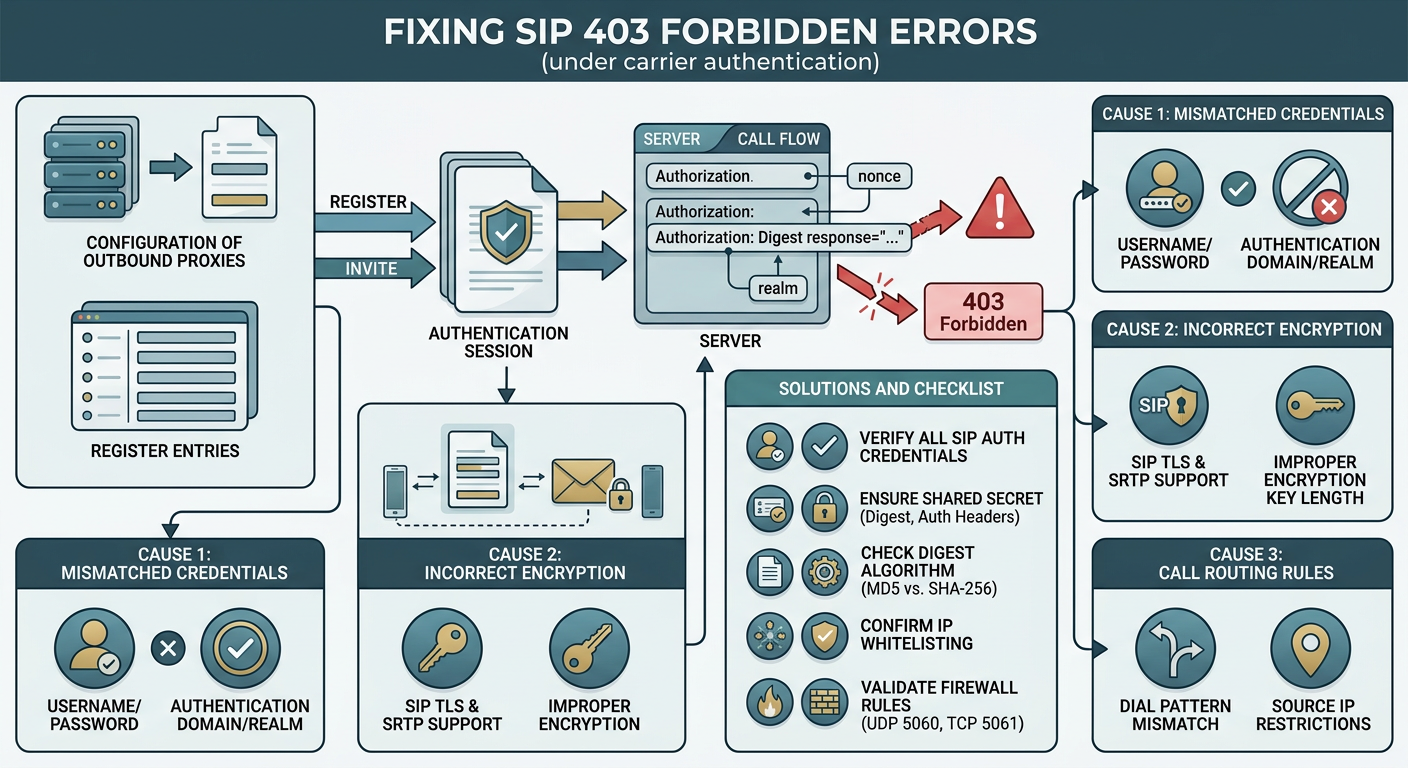
Symptoms
- Outbound calls terminate immediately with Asterisk cause code 21 (Call Rejected).
- SIP trace shows an initial INVITE followed by 401 Unauthorized/407 Proxy Auth, then the challenge-authenticated INVITE receives 403 Forbidden.
- Carrier returns reason header text like '403 Invalid Credentials', '403 From Domain Mismatch', or '403 IP Not Allowed'.
- Asterisk CLI displays 'WARNING[12345]: res_pjsip_outbound_authenticator_digest.c: Endpoint carrier-trunk: Digest authentication failed'.
Root cause
The carrier sends a 403 Forbidden due to one of three common issues: incorrect digest credentials (username/password/realm) in the PJSIP auth object, a mismatch between the 'From' domain/user header and the carrier's provisioned trunk identity, or sending traffic from an IP address not whitelisted in the carrier's portal.
Resolution steps
- step #1
Enable full PJSIP logging in the Asterisk CLI to capture detailed SIP header interactions with the carrier.
asteriskpjsip set logger on - step #2
Capture live SIP traffic using sngrep on the network interface to inspect the Authorization header and response parameters sent to the carrier.
bashsngrep -d eth0 proto SIP and host <CARRIER_IP_OR_FQDN> - step #3
Inspect
/etc/asterisk/pjsip.confto verify that theauthsection credentials,realm, and theendpointsection'sfrom_domainandfrom_usermatch the provider configuration exactly.ini[carrier-auth] type=auth auth_type=userpass username=provisioned_trunk_username password=ProvisionedSecretPass123! realm=sip.carrier.com [carrier-endpoint] type=endpoint transports=transport-udp context=from-carrier outbound_auth=carrier-auth server_uri=sip:sip.carrier.com from_user=provisioned_trunk_username from_domain=sip.carrier.com direct_media=no - step #4
Check the Asterisk dialplan to confirm the outbound Caller ID format complies with carrier requirements (e.g., E.164 +1NXXNXXXXXX vs 10-digit).
asteriskexten => _NXXNXXXXXX,1,NoOp(Outbound Call to Carrier) same => n,Set(CALLERID(num)=+12025550199) same => n,Dial(PJSIP/${EXTEN}@carrier-endpoint) - step #5
Reload the PJSIP module in Asterisk to apply the configuration updates.
asteriskmodule reload res_pjsip.so - step #6
Initiate a test call via Asterisk CLI to confirm the trunk accepts the authenticated INVITE and responds with 100 Trying and 180 Ringing/200 OK.
asteriskchannel originate PJSIP/+12025550123@carrier-endpoint application Playback tt-monkeys
Verification evidence
A captured SIP dialog shows Asterisk responding to a 401/407 challenge with an Authorization header containing an invalid digest MD5 response, or an unauthenticated initial INVITE rejected directly with 403 due to IP or From-URI header ACL violations.